

Mata Ni Pachedi
Mata-ni-Pachedi, also known as Kalamkari of Gujarat, has a striking origin story. This Gujarati textile art was born not out of temple patronage but out of exclusion. The Vaghri community of semi-nomadic people from around Ahmedabad were once barred from entering Hindu shrines to worship. So they built their own, painting the Mother Goddess directly onto cloth and using it as the walls of a temple that could travel with them. That cloth is called Mata-ni-Pachedi, which literally translates to "behind the Mother Goddess.”
The composition often involves a goddess sitting at the centre, framed within a pillared shrine, surrounded by rows of worshippers, ancestors and other gods and goddesses. All these are rendered through hand-block printing and hand-painting with natural dyes. Square versions are called Chandarvo, rectangular ones Lambo, and both were traditionally large enough to serve as canopies over an actual shrine.
Today, the craft survives largely in Ahmedabad, carried forward by families like the Chitaras. Sanjay Chitara still insists on natural pigments, just as his father did, while his son Sumit paints both traditional goddesses and contemporary scenes, sharing the work on Instagram. What began as a workaround for exclusion has, quite remarkably, become a legacy.

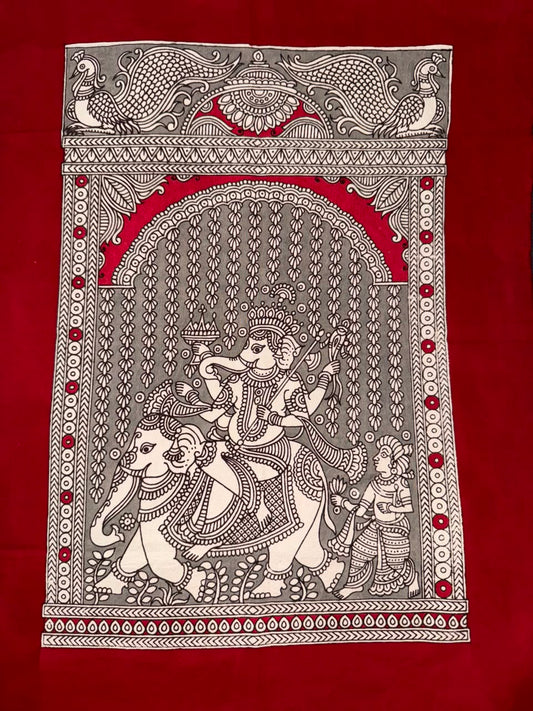
Ganapati
Kiranbhai Chitara
Natural Colours on ClothKiranbhai Chitara

Radha Krishna
Kiranbhai Chitara
Natural Colours on ClothKiranbhai Chitara

Momai Mata Ni Pachedi
Kiranbhai Chitara
Natural Colours on ClothKiranbhai Chitara

Durga Mata Ni Panchedi
Kiranbhai Chitara
Natural Colours on ClothKiranbhai Chitara

Bahuchara Mata ni Pachedi
Kiranbhai Chitara
Natural Colours on ClothKiranbhai Chitara

Mahakali Maa
Kiranbhai Chitara
Natural Colours on ClothKiranbhai Chitara

Parvati Maa with Bramha Vishnu Mahesh Ganesh
Kiranbhai Chitara
Natural Colours on ClothKiranbhai Chitara

Tree of Life - 1
Kiranbhai Chitara
Natural Colours on ClothKiranbhai Chitara

